PCC recently launched our collaborative robot line as a response to the need many companies are facing as they find it difficult to find qualified workers interested in the jobs they need filled. We found this topical article in Automation World which explains how a company utilized robotic technologies which enabled them to accommodate orders with much higher volumes and shorter delivery times.
As a supplier to companies like Volvo and Renault, FT-Produktion and its 25 employees have to be fast and flexible in response to customer orders. Collaborative robotic workcells and robot gripper technologies are enabling them to do that.
By David Greenfield , Director of Content/Editor-in-Chief, AutomationWorld.com on February 4, 2019
There’s no avoiding the many discussions about robots and automation technologies taking jobs. There’s also no avoiding the issue of how difficult it can be for companies to find either enough qualified workers or workers that are even interested in the jobs they have available—as was the case at Tennplasco’s injection molding operations. This is true not just in the U.S., but around the world.
A case in point is FT-Produktion, a Sweden-based supplier of metal parts used in the manufacturing of balconies, solar panels, electrical fixtures and trucks. The company manufactures 650 different aluminium profiles and fills 7,000 orders annually, with production runs ranging from five to 150,000 units.
Though Sweden has its own unique issues surrounding the recruitment of qualified employees (you can read more about this in my recent blog post), its businesses have to keep up with demand to stay in business. And in FT-Produktion’s case, that means delivering on orders from companies like Volvo, Renault and Scania.
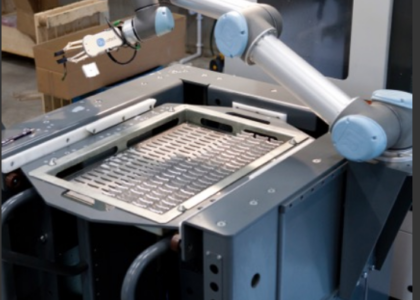
During a meeting with Edströms, a supplier of machinery used in its machine shop, FT-Produktion learned how collaborative robots (cobots) could help address its specific production needs. Based on what FT-Produktion learned, the company purchased a flexible robot cell featuring a UR5 cobot from Universal Robots, two RG2 robot grippers from OnRobot, and a ProFeeder modular robot cell from EasyRobotics in 2017.
According to FT-Produktion, by adding these three robotic technologies, the company was able to accommodate orders with much higher volumes and shorter delivery times without having to ask employees to work overtime. With the cobot cell working up to 16 hours a day, five days a week, FT-Produktion can now manufacture 150,000 units in less than two months.
Joakim Karlberg, co-owner of FT-Produktion, said the robotic investments paid for themselves in just nine months based on the additional business the company was able to add.
Prior to adding the robotic systems, an employee manually inserted four parts into a CNC machine, then waited 90 seconds before repeating this process again and again throughout the workday. According to FT-Produktion, this manual process can now be completed in five minutes with a worker only needing to manually fill one of the ProFeeder’s two movers. When the robot has emptied one of the mover’s parts trays, the operator removes the empty mover and inserts a filled mover into place in the ProFeeder, allowing the CNC to resume operation.
In this setup, the robot arm, outfitted with the RG2 double gripper, removes a raw part from the ProFeeder’s parts tray in the mover and inserts it in the CNC machine every 25 seconds. At the same time, the other gripper on the robot arm removes a finished part from the CNC machine and places it in a container. This is a key feature of the RG2 double gripper that, in effect, provides a robot arm with two hands.
This two-handed capability reduces cycle times by 12 seconds per task, meaning that FT-Produktion saves 500 hours when manufacturing a series of 150,000 parts.
“Robotizing the high-volume production run has enabled us to eliminate monotonous manual tasks, giving employees more time to work on smaller runs with greater variation in their tasks,” Karlberg noted.
Among FT-Produktion’s workforce, reception to the new robot technologies has been positive. Mikael Andersson, a machine technician at FT-Produktion, became a robot programmer and robot operator a year ago after two days of theoretical and hands-on training at Edströms. “Using the robots was actually more intuitive than I expected,” Andersson said. “It only takes 10 seconds to change to a different part on the robot’s display.”
Andersson added that “the robots are not taking any jobs. Instead, they’re enabling us to fill more orders and deliver more detailed parts with higher quality.”
Source: Article by AutomationWorld.com https://www.automationworld.com/article/industry-type/discrete-manufacturing/adding-capacity-multiple-robotic-technologies
PCC can help you with your next collaborative robot project. To learn more, contact us or visit our robot solution page here.